I don’t think you have to pick between commercial returns, social impact and environmental outcomes. The future belongs to businesses that can deliver all three. In the last nine months, Canopy Blue has been building both the foundations and the momentum to prove it can be done.
For those who haven’t met me yet, I’ve spent a decade in the seaweed sector, working on projects big and small around the world. At the start of this year I stepped into the role of CEO at Canopy Blue, my biggest project yet. Being the passionate Western Australian I am, I wanted to come home to share what I’ve learned about the global seaweed industry (the highs and the lows), and to help steer the industry towards maturity.
There is some way to go before Australia has a seaweed farming industry at scale, and the right locations are where it starts. Canopy Blue has access to marine areas ideally suited to seaweed cultivation. With that access, lessons from wild-harvesting companies around the world, and collaboration and stakeholder support, we can support multiple industries with high-value seaweed products.
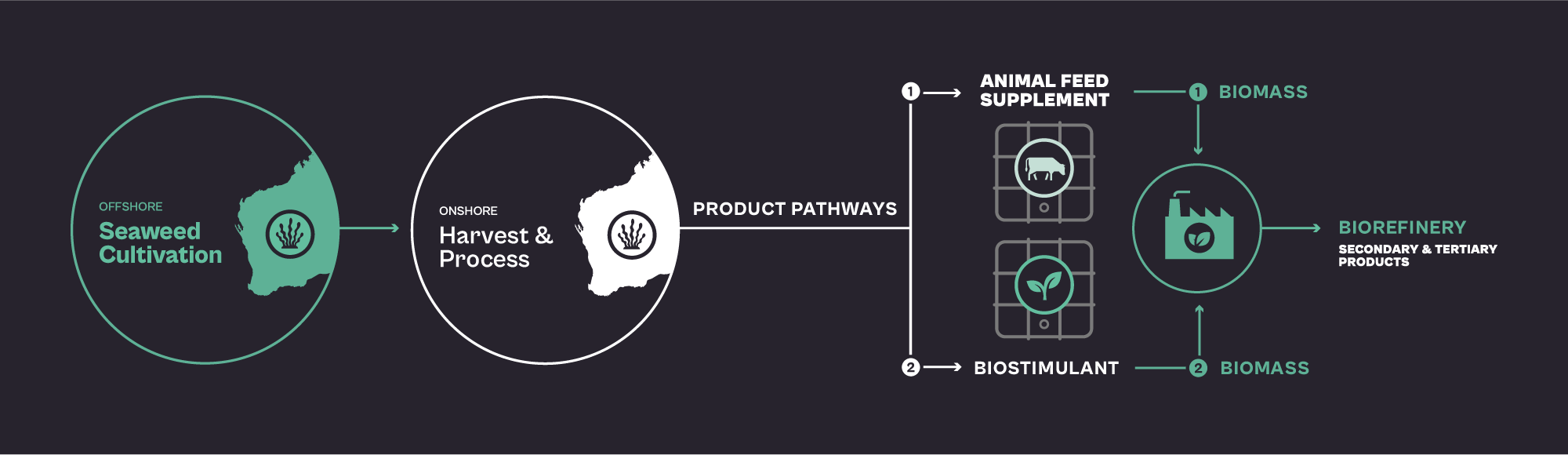
Canopy Blue is building three pathways from seaweed: an animal feed supplement, a biostimulant and bioprospecting. The last nine months have moved all three forward. The animal feed supplement is in production, and a feedlot trial is commencing. The partnership with the Kimberley Land Council (KLC) has deepened, and a new director is in the process of joining the board.
Canopy Blue is working with ProFauna, an Australian animal nutrition and manufacturing company, as a seaweed supply partner for Kelptonic, ProFauna’s fermented seaweed feed supplement developed for cattle.
Kelptonic is produced through ProFauna’s Australian manufacturing network, with parts of the production process also providing supported employment opportunities through charity and community organisations.
The product is being evaluated in livestock, with a commercial feedlot trial commencing in northern New South Wales and a further trial across larger open-grazing pastures in northern Western Australia under discussion.
CEO Joshua Masel recently visited ProFauna’s operations in New South Wales to see its existing manufacturing capability and discuss opportunities for future seaweed supply as production develops.
Demand is growing. ProFauna has seen continued growth across its agricultural product range, increasing the need for reliable, high-quality raw material supply. Seaweed is an important ingredient across a number of ProFauna products, and Canopy Blue has supplied material for ongoing Kelptonic production and trial work.
The work provides an early example of how Australian seaweed could be incorporated into practical agricultural products. Canopy Blue and ProFauna are continuing to explore longer-term seaweed supply and commercial arrangements as the program develops.
A biostimulant is a seaweed-based product that supports soil health and crop performance. Josh also visited Canopy Blue’s biostimulant partner, LawrieCo, in South Australia.
LawrieCo is pioneering the use of biostimulants in broad-acre farming in Australia as a key element of production improvements and carbon sequestration programs.
To achieve this we rely on quality, consistent seaweed inputs. Based on proposed systems and QA processes Canopy Blue are our desired partner to fill this long-term supply risk, and we look forward to expanding our product portfolios together.Mat Denton, LawrieCo CEO
LawrieCo’s field trials show that, with the right support and soil programs, broadacre farms can generate carbon credits and cut urea inputs by up to 75%. That is a direct financial benefit for farmers, alongside the longer-term health of the soil.
As a result, demand is rising for far larger volumes of biostimulants, with seaweed as one of the core ingredients. Canopy Blue and LawrieCo are collaborating on new seaweed inputs for LawrieCo products, and the first trials are under way.
On the back of those visits, Josh was invited to the KLC headquarters in Broome to meet CEO Tyronne Garstone. The KLC supports the Traditional Owners of the Kimberley. International frameworks describe organisations like it as Indigenous Peoples and Local Communities (IPLC). The KLC will hold a 20% equity stake and board seat in Canopy Blue, post capital raise. The two organisations share a goal: sustainable aquaculture on Country, with jobs and businesses that fit cultural values. Mr Garstone also sits on Australia’s Nature Repair Committee, a role he has held since September 2024.³
Through this partnership, there is also an opportunity to develop natural capital in the marine sector on Country. It would draw on generations of knowledge to map biodiversity gains at sea, through seaweed cultivation, and on land, through Canopy Blue’s products.
Josh and Mr Garstone then travelled together to One Arm Point to meet with the community. The community and Canopy Blue share a vision for a sustainable aquaculture hub on Country that could become a base for Canopy Blue operations and a centre for marine knowledge across the region.
The trip also included time with local communities to understand traditional practices with seaweed and what communities would like to see a seaweed industry achieve. That time set the baseline for the bioprospecting program described below.
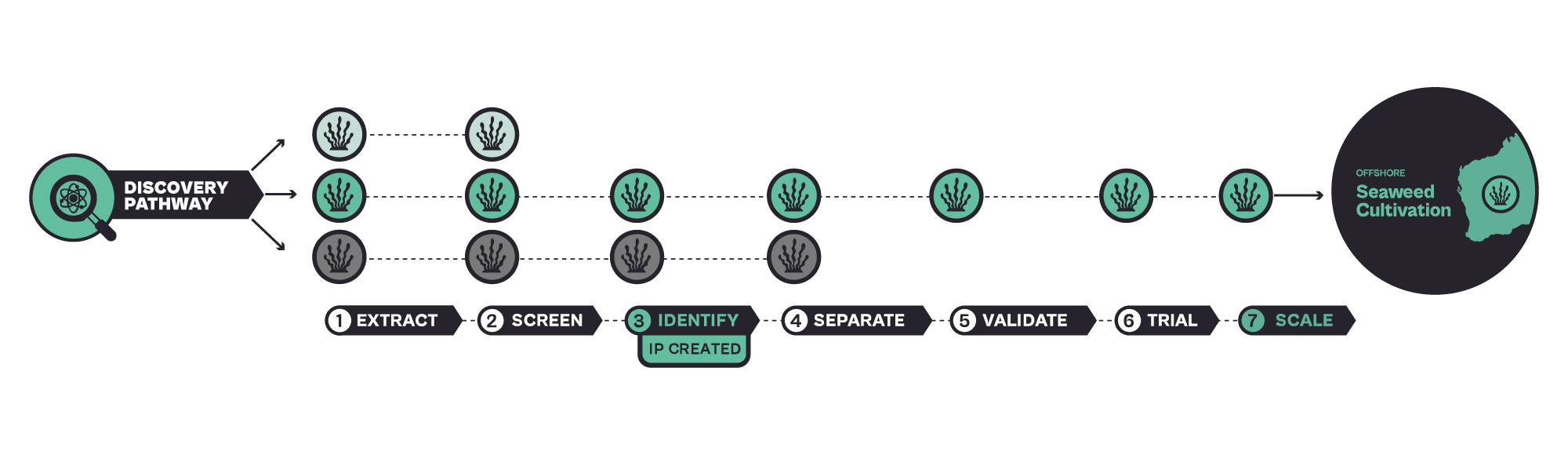
Bioprospecting is a program that screens native seaweed species for compounds with potential use in pharmaceutical, cosmeceutical and nutraceutical products. It works through engagement with local communities on Country, alongside the KLC. The aim is to identify which species found on Country have market interest and could eventually be cultivated and sold. It is part of the shared goal of sustainable aquaculture on Country, and growing only what is native and saleable helps create jobs that can last for generations.
The first seaweed samples have been received by Canopy Blue’s bioprospecting partner and are being screened to identify, and ultimately isolate, high-value compounds.
Today, with support from its partners and investors, Canopy Blue is ready for execution: the animal feed supplement is in production, the first biostimulant trials are under way, and the first bioprospecting samples are being screened.
That progress is drawing interest from investors across agritech, natural capital, biotech and impact investment. Only last month, Josh was in Geneva to meet and pitch to private equity groups and commodity traders, who remain engaged today, and then in the Netherlands to meet European investors who share a focus on agriculture.
Canopy Blue’s growing momentum is also reflected on the board, with Ingrid Kukuljan joining as a new director. Ingrid brings over two decades of expertise in impact investing and natural capital. She is an Expert Member of the International Advisory Panel on Biodiversity Credits (IAPB), established by France and the UK,⁴ which has developed the global framework for high-integrity biodiversity credits. That expertise is timely as Australia’s Nature Repair Market, a national, legislated biodiversity market designed to deliver high-integrity biodiversity outcomes, continues to develop.⁵
With two products under way, Indigenous governance through the Kimberley Land Council, Tyronne Garstone’s seat on the Nature Repair Committee and Ingrid Kukuljan’s role in shaping the global biodiversity credit framework, Canopy Blue is working towards becoming Australia’s most credible, investable seaweed business, with a high-integrity natural capital canopy covering it all.